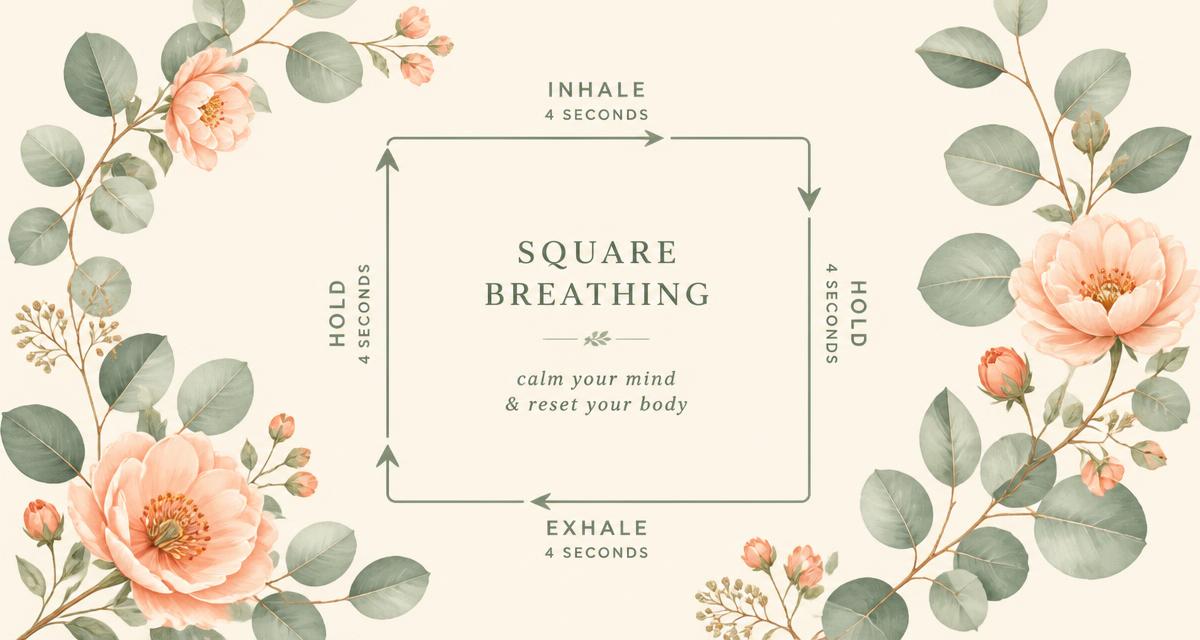
Box breathing is the technique we teach most often to people who say they "can't meditate." There is nothing to visualize, nothing to feel a certain way about, and no special place to sit. There is only a count of four, repeated four times around a square. That simplicity is exactly why it survives contact with real stress — a hard conversation, a merge onto the highway, a waiting room, the ten minutes before a performance review.
What box breathing is
Box breathing — also called square breathing or four-square breathing — divides one breath cycle into four equal four-second segments: inhale, hold, exhale, hold empty. One full round takes about sixteen seconds, which puts you near four breaths per minute, well below the twelve to twenty most adults take at rest. It is a form of paced breathing, and the pacing is the active ingredient.
Why it works: the physiology
Anxiety and chronic stress keep the sympathetic branch of your nervous system — fight-or-flight — running longer than it should. Breathing goes fast and shallow into the upper chest, heart rate climbs, muscles brace, and the thinking part of the brain gets less say in what you do next.
Slow paced breathing reverses that sequence from the body upward. Long, steady exhales stimulate the vagus nerve, which slows the heart and signals safety to the brainstem. Breathing at roughly six or fewer breaths per minute also increases heart rate variability — a well-studied marker of a flexible, resilient stress response. The equal counts add a second benefit: they occupy working memory, so there is less room for the anxious commentary running underneath.
You are not talking yourself into calm. You are changing the bodily state that mood sits on top of.
How to do box breathing, step by step
Sit upright with both feet on the floor and let your shoulders drop. If it helps, trace a square with your finger as you go.
1. Inhale for four. Breathe in quietly through your nose, letting your belly expand rather than lifting your chest.
2. Hold for four. Keep the air in without clenching your throat, jaw, or shoulders.
3. Exhale for four. Let the air out slowly and evenly through your mouth or nose.
4. Hold empty for four. Pause, then start the next round.
Run four to six rounds — about one to two minutes — and notice what changed. Most people report a looser chest, slower heartbeat, and a small gap between a trigger and their reaction. For daily nervous-system training, build up to three to five minutes once or twice a day.
When to use it
Box breathing is a before technique. It steadies you without making you drowsy, which makes it ideal ahead of a presentation, a difficult phone call, a medical appointment, a drive in heavy traffic, or a conversation you have been dreading. It also works well as a reset between tasks for people whose stress accumulates silently across a workday.
For winding down at night, a longer-exhale pattern is usually a better fit — we walk through 4-7-8 breathing, progressive muscle relaxation, and body scans in our guide to relaxation techniques for anxiety and stress.
Common mistakes
Inhaling too big
The most common error is treating "deep breathing" as a large breath. Big, forceful inhales blow off carbon dioxide and can cause light-headedness or tingling — which feels like anxiety and undermines the whole practice. Keep the breath modest and quiet; the pace is what matters.
Holding with tension
A hold is a pause, not a brace. If your throat, jaw, or shoulders tighten during the holds, shorten them to two seconds and let the rest of your body stay soft.
Only practicing during crisis
Skills rehearsed only during panic are rarely available during panic. Practice on ordinary days so the pattern is automatic when adrenaline arrives.
Variations worth knowing
Panic-friendly: drop the holds to two seconds, or remove them entirely and use a four-second inhale with a six-second exhale. Keep your eyes open.
Sleep-friendly: extend the exhale to six and shorten the empty hold, or switch to 4-7-8.
Tactical: the version many veterans learned in service — same counts, performed standing or seated with eyes open and situational awareness intact.
For kids: use three-second counts and trace a square in the air, on a palm, or along the edge of a book.
Box breathing and veterans
Many of the veterans and first responders we see already know tactical breathing from training, which makes it a natural starting point — the skill is familiar, non-clinical, and does not require closing your eyes or turning attention inward, both of which can be activating with a trauma history. Our veteran-led PTSD and transition care builds these skills into treatment rather than assigning them as homework.
When breathing is not enough
Box breathing lowers arousal. It does not treat an underlying condition. If worry is constant and hard to control, panic attacks keep recurring, low mood persists most days for two weeks or more, sleep stays broken, trauma symptoms intrude, or you are using alcohol or substances to wind down, it is time for an evaluation.
At Greene Mental Wellness we combine these skills with anxiety and depression care and, when appropriate, medication management. Families can explore child and adolescent services, and when restlessness and overwhelm look more like attention dysregulation, objective ADHD testing can bring clarity. See everything we offer on our services page or request an appointment.
We see patients in person in Wake Forest, NC and by secure telehealth across North Carolina — including Raleigh, Rolesville, Youngsville, Franklinton, and Louisburg.